

Over the last few weeks, I've had the opportunity to lead my final in person intensive of the year, and speak with several groups of entrepreneurs and high performers about two of the most important competencies we can develop in life.
The first is learning to manage our own emotional state.
The second is learning to create extraordinary relationships.
And one of the things that became especially apparent during these conversations was how closely those two competencies are connected.
Last week, we explored why the emotions we experience aren't actually caused by the circumstances we're facing. They're the result of emotional patterns conditioned within us, and learning to manage those patterns is fundamental to creating the life we want.
But there's another side to this.
The emotional state we bring into a relationship has a tremendous impact on how the other person experiences us.
And that experience, repeated consistently over time, ultimately shapes what the relationship becomes.
For entrepreneurs and high performers, this is particularly important because relationships can easily become the part of life we assume will take care of itself while we're busy building everything else.
We pour our energy into the business. We manage the team. We solve problems. We make decisions.
And then we come home carrying whatever emotional energy we've been operating in all day, without necessarily realizing that we're bringing that energy into one of the most important relationships in our life.
Emotions Have Rules
Think about the last time you were interacting with someone who was really angry with you.
Did you want to give them a hug?
Did you want to compliment them?
Did you naturally feel inclined to affirm and encourage them, or go out of your way to be supportive?
Probably not.
You likely wanted to get out of there. Or fight back. Or lash out.
Maybe you felt hurt and withdrew into yourself. Maybe you closed off, froze up, or isolated yourself.
That's a natural response to being around someone who's angry, especially when that anger is directed at you.
And if someone consistently shows up with anger, resentment, anxiety, insecurity, shame, or guilt, the people closest to them are continually having to respond to that energy.
Because emotions have rules.
They naturally create certain kinds of responses in other people.
Now think about what happens when someone consistently shows up with love, compassion, gratitude, peace, inspiration, and joy.
You naturally want to move toward them. You want to spend time with them. You feel inclined to affirm and encourage them.
You want to support them, help them, and collaborate with them.
And here's the part we tend to miss.
We often want the other person to respond to us differently without first considering what we're giving them to respond to.
What Are You Bringing Home?
One of the examples I shared recently was something I see frequently with high performers.
Let's say I've spent eight hours at work feeling anxious or overwhelmed.
Maybe things aren't going the way I want in the business. Maybe I'm frustrated with my team. Maybe I'm worried about something financially.
And I've been carrying that emotional energy within myself throughout the day.
Now I come home.
I'm not necessarily angry with Caitlyn. I'm not blaming her for what happened at work. I'm not directing my anxiety toward her.
But I haven't managed that energy either.
So when I walk through the door, it's still there.
It's in my nervous system.
It's influencing the way I think, the way I speak, the way I listen, and the way I interact.
And the person I'm coming home to now has to respond to that energy.
Even though it has absolutely nothing to do with them.
That's one of the reasons I encourage people to think about a relationship as having three aspects.
There's you.
There's the relationship itself.
And there's the other person.
The relationship is like a living, breathing entity that accumulates the emotional energy we bring into it through our interactions.
And it doesn't distinguish between the anger you're directing at your spouse and the anger you're carrying from a difficult day at work.
You're still feeding that energy into the relationship.
Hour by hour. Day by day. Week after week. Month over month.
And eventually, those micro impacts produce the reality of the relationship.
Relationships don't become extraordinary overnight. And they don't typically reach the brink of breaking overnight either.
They become what we consistently create through the way we show up.
You Can't Manage Their Side
One of the most helpful things people took away from these recent workshops was the idea that a relationship isn't fifty-fifty.
It's 100% your responsibility.
That doesn't mean you're responsible for the other person's behavior.
In fact, it's the opposite.
Stop making yourself responsible for what the other person is doing.
And stop making the other person responsible for how you feel.
Take ownership of your side of the relationship.
Because who you are, and who you bring yourself as to the relationship, will ultimately influence what that relationship becomes.
And this is where the vision matters.
What kind of relationship do you aspire to create?
What do you want your life together to look like?
What do you want the experience of being together to feel like?
And most importantly:
Who do you need to be to create that relationship?
Not what does your spouse need to do differently.
Not what needs to change in the household.
Not what circumstances need to improve.
Who do you need to be?
Because when you begin showing up as the higher version of yourself, aligned emotionally, mentally, and physiologically with the vision you have for your relationship, the other person now has something different to respond to.
And that changes the dynamic.
The Foundation of Relationship Alchemy
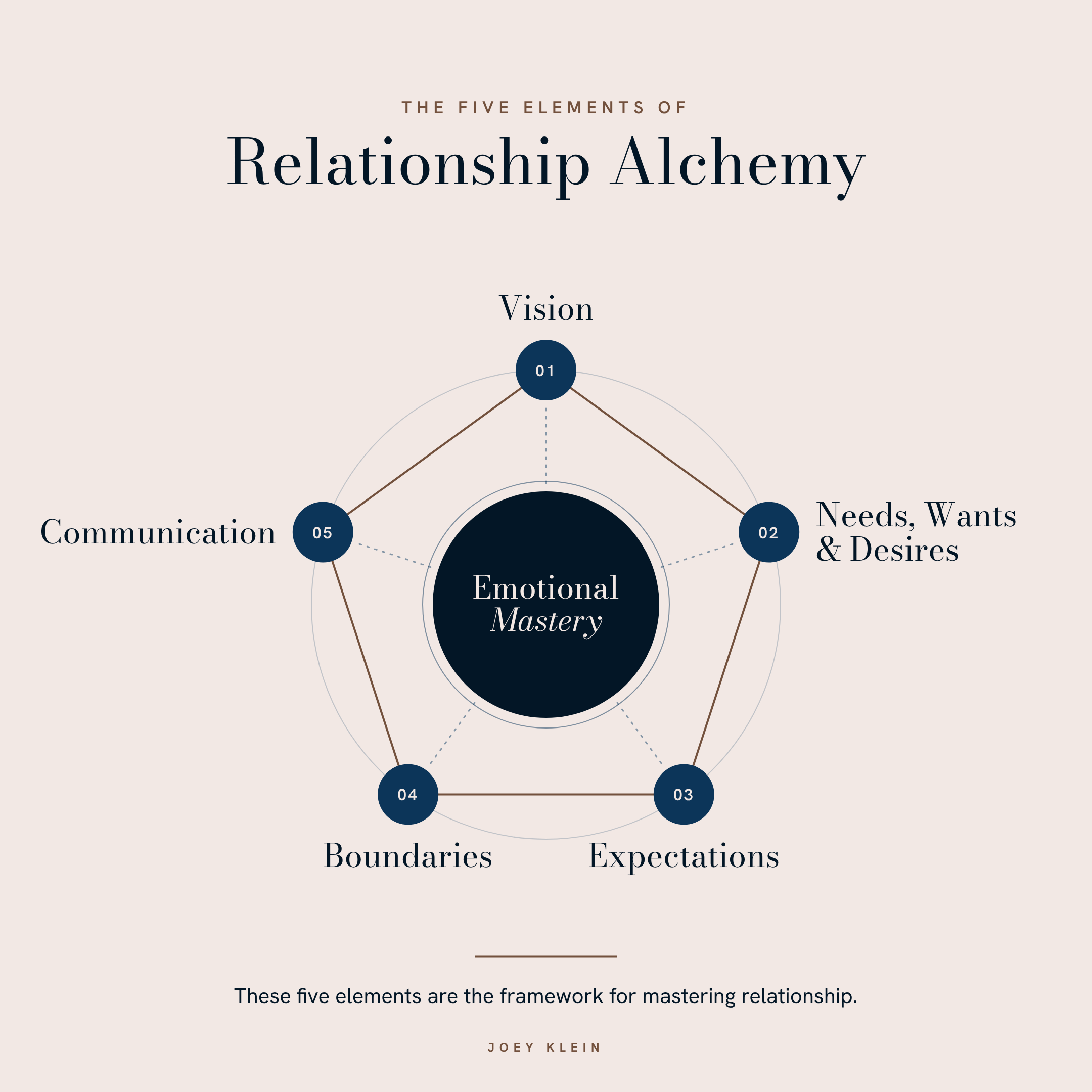
When I teach the Elements of Relationship Alchemy, we work with five essential elements for creating extraordinary relationships.
Vision.
Needs, Wants, & Desires.
Expectations.
Boundaries.
Communication.
And at the center of all five is emotional mastery.
Because you can have a clear vision for your relationship and still bring anger or resentment into it every day.
You can know exactly what you need, want, and desire, but struggle to communicate those things constructively when you're emotionally activated.
You can understand expectations and boundaries intellectually, but have a very difficult time managing either one when you're operating from anxiety, frustration, or insecurity.
This is where the emotional ownership we talked about last week becomes so important.
You have to bring an emotionally competent person to the relationship before you can truly optimize the relationship itself.
When you manage your emotional state and consistently bring love, compassion, gratitude, joy, and peace into the relationship, the other person naturally begins responding differently.
They want to come toward you. They want to spend more time with you. They become more inclined to affirm, encourage, support, and collaborate with you.
And many of the dynamics that previously seemed like enormous problems begin resolving themselves.
That's why I tell people that simply showing up as the best version of themselves, aligned with the vision they have for their relationship, can solve 98% of their relationship challenges.
Not because communication doesn't matter.
Not because expectations and boundaries aren't important.
Not because there aren't legitimate challenges that need to be addressed.
But because those things become much easier to manage when you're operating from a supportive emotional state.
Think about how differently you communicate when you're angry versus when you're compassionate.
Think about how differently you receive feedback when you're resentful versus when you're centered and peaceful.
Think about how much easier it is to make a request or name an expectation when you're approaching the other person from gratitude rather than frustration.
Even the remaining two to five percent of challenges become far more manageable.
Communication. Expectations. Boundaries. Requests for changes in behavior. Problem-solving.
All of those competencies matter.
But they're secondary to who you are bringing into the relationship.
And that's why emotional mastery and relationship mastery are so closely connected.
The Person They Want to Come Home To
There's a subtle but important distinction here.
The goal isn't to show up with gratitude and compassion so that your spouse will finally do what you want.
That would simply be another way of trying to manage the other person.
The goal is to become the person who naturally brings those qualities into the relationship because that's who you've chosen to be.
It's the standard you're holding yourself to.
It's the person who aligns with the vision of the life you want to create.
And when you do that consistently, the relationship begins responding to you differently.
You no longer need to spend the majority of your attention trying to figure out how to get the other person to change.
You can put ninety percent of your focus on the part of the relationship you actually control.
Yourself.
And from that place, you can tend to whatever else needs attention.
Maybe you need to have a difficult conversation. Maybe you need to establish a boundary. Maybe there's an expectation that needs to be named. Maybe you need to develop better communication or problem-solving skills together.
Those things don't disappear simply because you're bringing better energy into the relationship.
But now you're approaching them as the person capable of creating the relationship you actually want.
And the other person is much more likely to receive you differently.
Because emotions have rules.
And the energy you consistently bring into the relationship influences the experience the other person has of being with you.
Over time, that experience becomes the relationship.
So if you want to create something extraordinary with another person, begin by asking yourself a different question.
Not, How do I get them to become the person I need?
But:
Am I becoming the person capable of creating the relationship I want?
Other Ways to Engage
Last week, in Issue 038 — Your Emotions Aren't Caused by What You Think, we explored why emotional patterns aren't created by the circumstances happening around us, and how mastering our emotional state changes our ability to create the outcomes we want.
I'd also revisit Issue 031 — Another Million Dollars Won't Fix Your Marriage. But This Will, where we explored why changing external circumstances doesn't repair the internal patterns that shape a relationship.
And as always, you can find The Connection Fix on the Blog and The Connection Fix Podcast.
One Question to Sit With
Before I wrap...
Think about the person closest to you.
The person who experiences you when the workday is over, when the demands of life are still there, and when you don't have anything left to prove.
What is it like for that person to be with you?
Not what you intend.
Not how much you love them.
Not what you wish they understood about you.
What do they actually experience when they're with you?
And if you were on the receiving end of that experience every day...
Would you want to come closer?
Or would you want to pull away?
Because the answer may tell you more about what your relationship needs than another conversation about what the other person should change.
More soon.
Have a great rest of your day, and I'll look forward to connecting again next week.
Joey