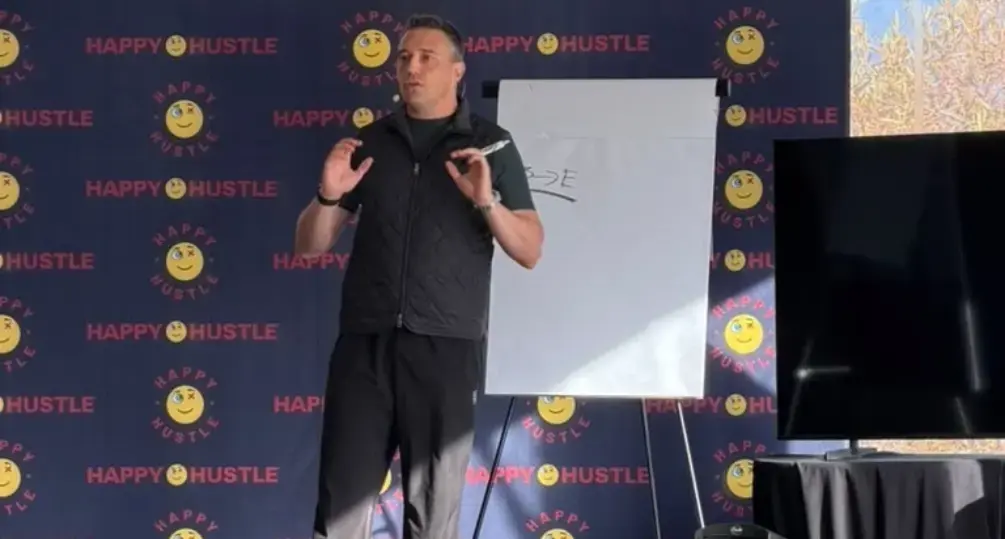
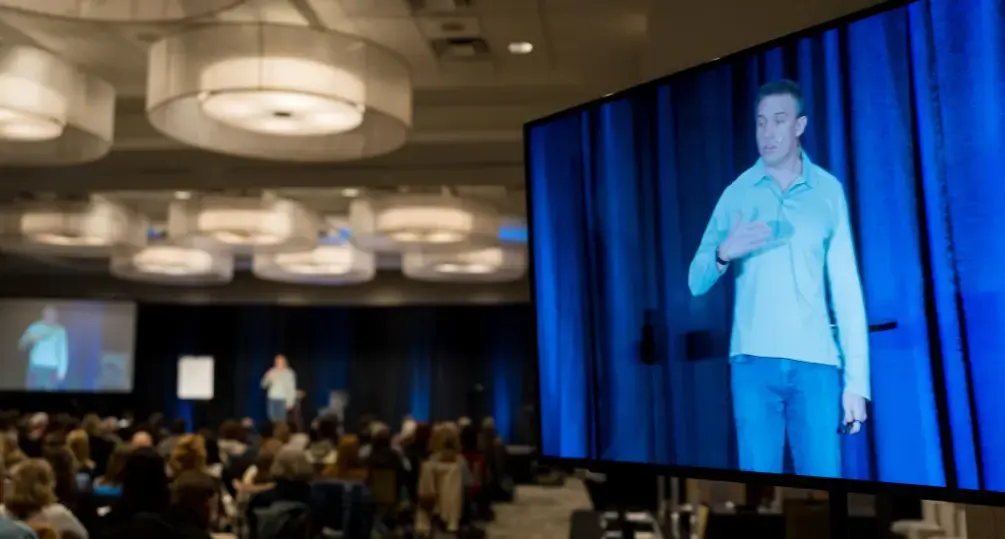
As this issue launches, I’ll be wrapping up facilitating my final in-person intensive of the year: Power of Intuition in Denver. And for the few weeks prior, I’ve had the opportunity to speak at three additional events with groups of entrepreneurs and high performers. One of those events included entrepreneurs and their significant others.
And something interesting happened.
Across three different groups of people, one of the concepts that seemed to create the biggest shift in perspective was also one of the most foundational principles of Inner Matrix Training.
It’s something I’ve been working with people on for twenty-four years, and yet I’m continually reminded how easy it is to forget.
Especially when we're emotionally activated.
The emotions you feel are not the byproduct of what's happening around you.
They're not caused by your circumstances, your environment, or what another person is doing.
They're the byproduct of emotional patterns that were conditioned within you long before the present moment.
And understanding that distinction changes everything about how you manage yourself, your relationships, and the life you're creating.
It's also foundational to the work we're doing this weekend at Power of Intuition. Because intuition isn't simply something we learn to listen for. We have to cultivate the internal state that allows us to access it.
And that begins with emotional ownership.
The Emotion Didn't Begin Here
Let's use anger as an example.
Someone does something you don't like.
Maybe they disrespect you. Maybe an expectation isn't met. Maybe somebody at work makes a decision that creates a problem you now have to deal with.
And you get angry.
The natural conclusion is that you're angry because of what happened.
I'm angry because they disrespected me.
I'm angry because they didn't do what they said they would do.
I'm angry because this situation is unacceptable.
But what if the anger you're feeling isn't actually the result of what just happened?
What if that situation simply activated an emotional pattern that was already there?
From a neurological perspective, the emotional responses we experience today were conditioned and trained through our past experiences.
And much of that conditioning happened long before we had the language or cognitive ability to understand what was happening.
Think about an infant.
Before we have words, before we can articulate a thought or explain what we're experiencing, we're already communicating through sensation and emotion.
Hot and cold.
Pain and pleasure.
Anger.
Sadness.
Joy.
If you've ever spent time around an infant or toddler, you've seen how completely they express emotion. There's no filter.
And for the first years of our lives, emotion and sensation are our primary ways of experiencing and communicating with the world.
Those patterns become conditioned within our nervous systems. And unless we intentionally learn to retrain them, many of those same emotional dynamics continue operating years or decades later.
We may be forty or fifty years old, running a successful business, raising children, and managing enormous responsibility.
And still responding emotionally through patterns that were conditioned when we were very young.
The circumstance may be new.
But the emotional pattern isn't.
You Don't Have to Go Back to Go Forward
One of the things people often assume is that to change an emotional pattern, they need to figure out where it came from.
They need to go back into their childhood.
Find the event.
Understand why they became angry or afraid or insecure.
But the reality is, you're probably not going to know exactly where the pattern originated anyway.
If you feel angry today and start looking through your past for moments when you were angry, you're going to find plenty of them.
Yesterday.
Six months ago.
Ten years ago.
When you were a child.
But finding examples of when you experienced an emotion doesn't mean you've identified what originally conditioned it.
A great deal of emotional conditioning happened before you had language, before you could consciously interpret an experience, and before you could form memories in the way you do today.
So going into the past isn't what's necessary for learning to manage the emotion.
What's necessary is becoming aware of what you're feeling right now.
And taking 100% ownership of it.
Not assigning responsibility to the person you're speaking with.
Not assigning responsibility to the circumstance.
Not waiting for something outside of you to change so you can feel differently.
Recognizing that the emotion is occurring within your own nervous system, your own brain, your own Inner Matrix.
And that managing it is your responsibility.
Your Emotions Tell You Where You Are
Here's the distinction I want you to really consider.
Your emotions aren't there to inform you about what's happening. They're there to inform you about where you are.
We tend to treat emotion as evidence about reality.
I feel angry, so somebody must have wronged me.
I feel afraid, so something must be dangerous.
I feel insecure, so something must be wrong with me or my circumstances.
But the emotion is actually telling you something about your own internal state.
And that matters because your emotional state drives the way your mind thinks, what it focuses on, and how it interprets what's happening.
Every emotion has its own predictable way of thinking.
When you're angry, your mind looks for what's wrong, who's responsible, and why your anger is justified.
When you're anxious, your mind looks for what might go wrong.
When you're resentful, your mind finds more reasons to feel resentful.
And the thoughts your mind produces then reinforce the emotional state you're already experiencing.
Emotion drives thought.
Thought fuels more of the same emotion.
And unless you recognize that pattern and learn to manage it, you can become caught in a cycle that continually reinforces itself.
Think about the last time you became really angry.
Maybe you said something to your spouse that wasn't constructive.
Maybe you reacted to an employee in a way that broke down trust.
Maybe you made a decision from frustration that you later wished you'd handled differently.
In those moments, we can become convinced that our anger is justified and that acting on it is the appropriate response.
But look at what actually happens.
The words we say and the actions we take while we're angry end up breaking down the very relationships we're trying to improve.
They move us away from the outcomes we're trying to create.
And instead of solving the problem, we often create another one.
Because when we're operating from anger, resentment, anxiety, or other fear-based emotional states, we're not accessing the higher cognitive functions necessary to see the circumstance clearly and respond effectively.
We're not fully leveraging critical thinking.
We're not fully leveraging creative thinking.
We're not accessing intuition in the way we need to.
And those are precisely the capacities we need to solve problems and create the future we want.
The Inflection Point
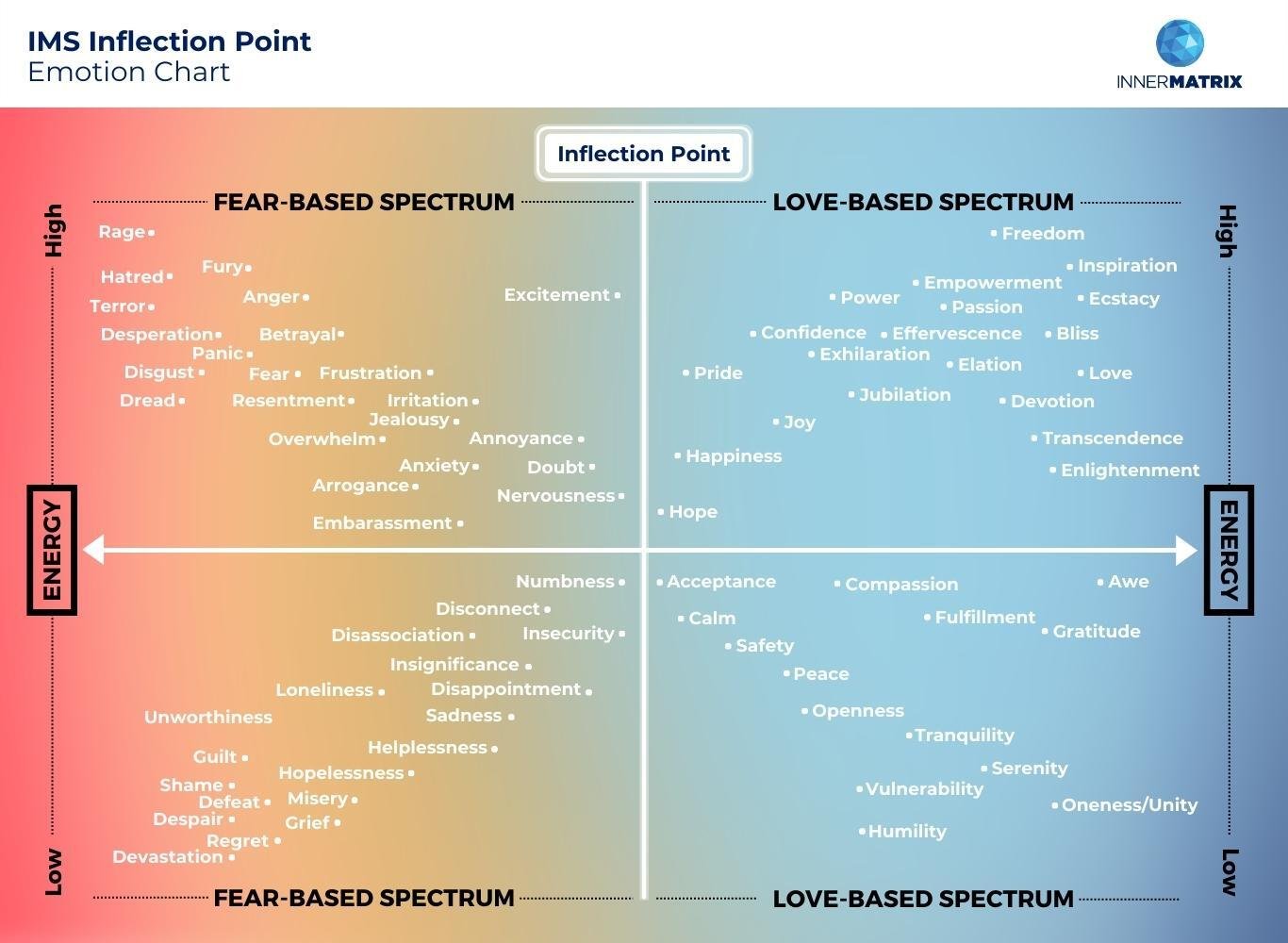
This is why emotional mastery is so much more than simply feeling better.
Take a look at the Inflection Point Emotion Chart.
On the left side of the inflection point is the fear-based emotional spectrum. Anger, resentment, anxiety, frustration, shame, insecurity, and other emotions that tend to narrow our perception and drive predictable patterns of thinking and behavior.
On the right is the love-based emotional spectrum. Gratitude, compassion, peace, acceptance, inspiration, joy, and other states that support a very different experience of ourselves and the world.
The inflection point is the distinction between those two ways of operating.
When we're on the fear-based side, our perception of reality changes.
We see circumstances through the lens of anger, fear, resentment, insecurity, or whatever emotional pattern is active.
Our minds produce thoughts consistent with those emotions. And then we make decisions from that place.
But when we learn to cultivate states like inspiration, passion, peace, or simply feeling centered and calm, we have greater access to the cognitive functions that allow us to see the situation more accurately.
We can think critically.
We can think creatively.
We can access intuition.
And now we're in a much better position to ask the questions that actually move our lives forward.
What am I trying to create?
What is the outcome I want?
What's the most effective way to respond to what's happening?
This is the heart of emotional management. Learning to recognize which side of the inflection point you're operating from, center yourself, and consciously shift your emotional state rather than continuing to run the same conditioned pattern.
Whether the vision is to create a deeper connection in your marriage or to scale your business ten times from where it is today, the same principle applies.
You need access to the internal state that allows you to bridge the gap between where you are and where you want to be.
And the emotion you're experiencing is giving you information about whether you're in that state.
It's not telling you whether the world is right or wrong.
It's telling you where you are within yourself.
Your Emotion Creates Your Reality
When we talk about creating a vision for our lives, it's easy to become focused on the big outcomes.
The business we want to build.
The relationship we want to have.
The financial freedom we want to experience.
The person we want to become.
But the future isn't created all at once.
It's created through the accumulation of what we do in the present moment.
The decisions we make.
The words we choose.
The way we interact with people.
The actions we take.
The emotional experience we cultivate within ourselves.
I think of it as planting microseeds.
Each moment is an opportunity to plant another seed that moves us toward the reality we want to create.
And our emotional state determines the quality of those seeds.
If I'm operating from anger or resentment, the thoughts, actions, and communication that follow are likely to move me away from my vision.
If I'm operating from inspiration, passion, peace, or a centered state, I'm much more likely to think in ways and make choices that move me toward it.
Not just toward an external result, but toward the actual experience I want to have while living my life.
That's what it means to become a conscious creator of your reality.
And it's why we say that reality is created from the inside out.
The Responsibility Is Yours
One of the most transformational things you can do is stop treating your emotional experience as something the world is doing to you.
That doesn't mean the world doesn't present challenges.
People will still behave inappropriately.
Expectations will still be missed.
Businesses will still encounter problems.
Relationships will still require work.
But none of those circumstances changes the fundamental responsibility you have for your own emotional state.
When anger arises, you can recognize it as an emotional pattern rather than treating it as a command to act.
When anxiety appears, you can recognize that you're not in the optimal state to make the next important decision.
When resentment shows up, you can recognize that the emotion is telling you something about where you are, not necessarily the truth about the person standing in front of you.
And then you can begin managing yourself differently.
You can train yourself to cultivate the states that allow you to think clearly, access intuition, and take actions aligned with the vision you're creating.
This is simple in concept.
It takes training to become competent at it.
But it's the foundation of everything else.
Because if you can master your emotional state, you can master how you show up in your relationships, in your business, and in the circumstances of your life.
And that changes what becomes possible.
Mastering emotion is how we master ourselves.
And mastering ourselves is the key to mastering life and reality.
Next week, I want to take this principle into one of the places where emotional ownership can be both the most challenging and the most transformational.
Our relationships.
Because when someone we love is standing right in front of us, it's especially easy to forget where our emotions are actually coming from.
And that changes everything about how we connect.
Other Ways to Engage
If this conversation resonated, I'd revisit Issue 026 — The Exhaustion Myth where we explored how the emotional state we live in affects our biology, our energy, and our capacity to create.
And as always, you can find The Connection Fix on the Blog and The Connection Fix Podcast.
One Question to Sit With
Before I wrap...
Think about the last time you felt angry, anxious, resentful, or insecure.
Maybe it was this morning.
Maybe it was yesterday.
Maybe it's something you're experiencing right now.
What did you believe was causing that emotion?
And what would change if you stopped treating that circumstance or person as the cause and started recognizing the emotion as something happening within you?
Not something you have to obey.
Not something somebody else has to fix.
Something you can learn to manage.
Because the moment you take ownership of your emotional state is the moment you begin to take ownership of what you're creating.
More soon.
Have a great rest of your day, and I'll look forward to connecting again next week.
Joey