


Over the last several weeks, we've talked a lot about what it takes to create an extraordinary relationship.
We've explored emotional ownership, the importance of vision, and how the energy we consistently bring into a relationship shapes what that relationship becomes.
And I've been pretty consistent about one thing.
Most relationships can become extraordinary when we're willing to do the work.
But there's a question I get asked that deserves its own conversation.
How do I know when it's time to leave?
Not when the relationship is difficult. Not when we're frustrated or struggling to connect.
But when do we actually know that the relationship we're in is no longer capable of becoming the relationship we aspire to have?
Because while the overwhelming majority of relationships can be transformed, there are circumstances where the most aligned decision is to transition the relationship.
And today, I want to speak to that small percentage.
Most People Leave Too Soon
In my experience, most people who end a relationship do so before they've fully explored what's possible.
They find themselves in a difficult season. Maybe they're arguing more frequently. Maybe intimacy has diminished. Maybe they feel disconnected or resentful.
And they begin to believe the relationship itself is the problem.
But when we look more closely, many of these couples are aligned on the things that matter most.
They share a similar moral constitution. They want many of the same things for themselves, each other, and their family.
Ninety percent of what's most important is already there.
What they're experiencing is a difficult season.
And difficult seasons are part of long-term relationships.
As we evolve, our partners evolve. We move through different phases of life, different responsibilities, and different versions of ourselves.
We have to continually recalibrate. Redefine who we are, who we're becoming, and how we want to be with each other.
Sometimes we have to work through emotional patterns that have been operating within us for decades. And sometimes we have to stay with the discomfort longer than we think we should.
Because that process often creates the deeper intimacy, trust, and connection we were hoping to find.
If you leave a relationship to escape your own emotional patterns, those patterns tend to follow you into the next one.
You don't get a pass simply because the person standing in front of you has changed.
That's why I encourage people to start with themselves before deciding whether a relationship should continue.
But what if you've done that work and still recognize that the relationship may not be capable of supporting the life you want?
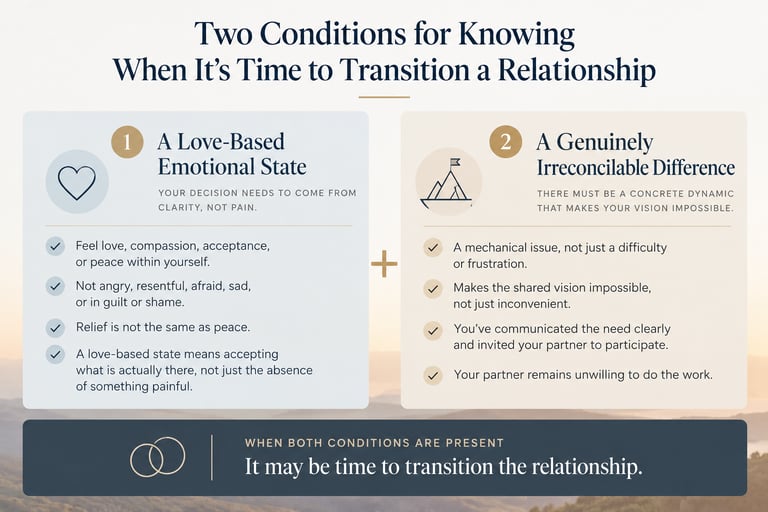
That's when I look at two conditions.
The First Condition: Your Emotional State
The first thing I want to know is what emotional state you're operating from.
If you're angry, resentful, afraid, sad, or caught in guilt or shame, you're not in the optimal state to make a clear decision about the future of your relationship.
That doesn't mean the challenges you're facing aren't real.
It means your emotional state is influencing the way you're perceiving them.
As we explored in Issue 038, your emotions aren't there to tell you what's happening. They're there to tell you where you are.
When you're resentful, your mind finds more reasons to feel resentful.
When you're angry, it finds more evidence that the other person is wrong.
And from that place, it's easy to conclude the relationship is beyond repair.
But that's not necessarily clarity.
So the first condition is whether you can genuinely access a love-based state.
Can you feel love within yourself?
Can you experience compassion for yourself and the other person?
Can you look at the relationship from acceptance and peace?
And there's an important nuance here.
Relief is not the same thing as peace.
I've worked with people who are convinced they're ready to leave because the thought of being out of the relationship feels wonderful.
I won't have to deal with the arguments anymore.
I won't have to feel this pressure.
But what they're often experiencing is sadness or disappointment.
They're imagining the absence of something painful.
That's different from genuinely cultivating love, compassion, acceptance, or peace within themselves.
A love-based state isn't simply the absence of something that's been bothering you. It's being at peace within yourself while fully accepting what's actually there.
And from that state, you can begin to see the relationship clearly.
The Second Condition: Is the Vision Actually Impossible?
Let's say you've done the emotional work.
You can feel love and compassion for the other person. You're at peace within yourself.
And you still recognize that the relationship may not support the life you want to create.
Now we need to look at something concrete.
Is there a genuinely irreconcilable difference that makes your vision impossible?
The key word is impossible.
Not inconvenient. Not frustrating.
Impossible.
And often, these differences are mechanical in nature.
Imagine that one of your most important aspirations is to build meaningful wealth and financial freedom.
But your spouse is fundamentally unwilling to develop financial competency.
They're opening credit cards without telling you, accumulating debt, and spending money without regard for your financial agreements.
You've communicated clearly and invited them to work with you.
But they're unwilling to participate in any system that would allow you to build the future you envision.
That dynamic may make your vision impossible.
Here's another example.
Maybe you envision growing older with someone who prioritizes health and vitality.
You want to travel, stay active, and experience life together.
But your spouse is actively disregarding their health, despite serious warnings and opportunities to make changes.
And they're unwilling to take steps within their control that would support the future you want to share.
That may represent a fundamental incompatibility.
It's different from someone experiencing an illness or health condition outside their control. Those circumstances deserve compassion and thoughtful consideration.
The distinction is whether there's a pattern of unwillingness making the shared vision impossible.
A Need Is Not the Same as a Strong Want
This is where clarity becomes especially important.
Because we sometimes confuse something we strongly want with something we actually need.
A need is something that must be present for the vision to be possible.
A strong want is something we'd really enjoy having, but that doesn't necessarily determine whether the relationship can fulfill its purpose.
Maybe you love running marathons and wish your spouse would run them with you.
But they don't enjoy running.
That doesn't make the relationship incompatible.
You can run with friends. Your spouse can support you without participating in every activity you enjoy.
The deeper need might be that you're both committed to caring for your health and creating an active life together.
Those are very different expectations.
Before you decide something is irreconcilable, make sure you're not treating a strong preference as an absolute requirement.
And make sure you've communicated that requirement.
Sometimes people conclude their partner is unwilling to meet a need they've never clearly expressed.
They haven't explained why it matters or genuinely invited the other person to participate.
Sometimes the conversation is as straightforward as saying:
This is something I need in order for us to create the life I envision together.
I want us to have that life. I want us to be together.
And if this doesn't begin to change, I don't see a way for us to continue creating that future together.
That's not about threatening someone into compliance.
It's about communicating honestly, from a supportive emotional state, so the other person understands what's at stake.
And in my experience, many people are willing to participate once that conversation happens clearly.
But sometimes, even after you've done that work, the other person remains unwilling.
And that's a different reality.
The Five Percent Reality
Over the years, I've often described relationship outcomes using a ninety-ten distinction.
But after working with thousands of people, I think it's useful to be more specific.
In my experience, roughly ninety percent of relationship difficulties can be resolved when both people are willing to train themselves and develop the competencies required for an extraordinary relationship.
Then there's another group, perhaps around five percent, where the relationship was workable, but one or both people simply weren't willing to do the work.
The opportunity was there.
The commitment wasn't.
And then there's a very small percentage, somewhere in the range of one to five percent, where the relationship is genuinely unworkable.
Maybe the two people were never aligned on what mattered most.
Or maybe they've changed so substantially that their visions for life are fundamentally different.
These aren't precise statistical categories. They're distinctions I've come to recognize through years of working with people and their relationships.
And the important thing isn't the exact percentage.
It's recognizing that a challenging relationship and an impossible relationship are not the same thing.
For most people, the next step isn't to leave. It's to develop the emotional competence, clarity, and resilience necessary to work through difficult seasons together.
But for the small percentage who have genuinely done that work and still face a fundamental incompatibility, transitioning the relationship may be the most aligned decision.
nullnullnull18473372"module"When You Know
So how do you know?
You don't know simply because you're exhausted.
You don't know because the thought of leaving feels like relief.
And you don't know because the relationship is going through a difficult season.
You begin to know when you can look at the relationship from genuine love, compassion, acceptance, and peace.
When you've taken ownership of your emotional patterns.
When you've clearly communicated what you need and invited the other person to participate.
And when you can identify an irreconcilable dynamic that makes your vision impossible.
When those conditions are present, it may be time to transition the relationship.
And that decision doesn't come from anger or resentment.
You can love someone. You can have compassion for them. You can appreciate the life you've shared.
And still recognize that the relationship is no longer capable of becoming what you aspire to create.
Other Ways to Engage
If you're questioning whether your relationship can become what you want it to be, revisit Issue 039 — The Person They Want to Come Home To, where we explored how your emotional state influences what becomes possible in a relationship.
I'd also recommend Issue 032 — The Quiet Exit, where we explored how relationships lose connection and what it takes to begin rebuilding it.
And as always, you can find The Connection Fix on the Blog and The Connection Fix Podcast.
One Question to Sit With
Before I wrap...
If you're questioning whether a relationship in your life should continue, ask yourself:
Is this relationship genuinely incapable of becoming what I envision, or am I in a season of difficulty that I haven't yet learned how to navigate?
It's an important distinction.
A difficult season may call for growth, resilience, and a willingness to do the work together.
Genuine incompatibility may mean it's time to transition the relationship.
And it's important to know which one it is.
More soon.
Have a great rest of your day, and I'll look forward to connecting again next week.
Joey