


This photo was taken when Caitlyn convinced me to do an engagement shoot at a quiet railway station.
And no — the train wasn’t moving.
If you know me, you know professional photo shoots are not exactly my favorite pastime. I’m much more comfortable teaching a room of 300 people than posing next to a vintage trolley car pretending I actually hang out at train depots.
But it mattered to her.
So I opted in.
I didn’t just opt in reluctantly. I didn’t do it resentfully.
I did it with intention, I did it consciously. I brought the best version of myself to the process because the reality was it was important for her.
Because when you’re clear about the vision for your relationship, you understand something important:
You don’t have to love every preference.
But you do have to decide what you’re going to show up for and what you’re not willing to show up for.
And that’s a perfect doorway into what we’re talking about this week.
Boundaries.
If you’ve been following this series, you can feel the progression:
Vision gives us context.
Needs, Wants, and Desires clarify what matters.
Expectations are how we hold those with real people.
And boundaries are how we uphold them.
Boundaries are probably the most talked-about — and most misunderstood — part of relationship.
So let’s clear it up.
What a Boundary Actually Is
A boundary is simply the way we uphold expectations with other people.
That’s it.
It’s not a wall.
It’s not a threat.
It’s not a dramatic line in the sand.
A boundary is the container through which your expectations are honored.
If you’ve already clarified your vision, defined your needs, wants, and desires, and evaluated whether your expectations are reasonable, then a boundary is simply how you uphold that expectation with another person.
Here’s the distinction most people tend to miss:
You can only have a boundary if you can uphold the boundary.
If you cannot uphold it, there is no boundary — only frustration.
The Biggest Mistake People Make
Most people use boundaries in an attempt to control or manage the other person’s behavior.
They try to get someone to do something.
Or stop doing something.
Or become someone different than they are.
And this inherently fails.
You cannot control another person’s nervous system.
You cannot make someone want what they don’t want.
You cannot force emotional alignment.
The moment you try, you lose power — because you’re attempting to manage something that is inherently outside your control.
Boundaries are not about managing the other person, it's not about managing them.
They are about managing your space.
How Boundaries Actually Work
Once you’ve clarified an expectation, you communicate it.
Not as:
“You’re wrong.”
Or:
“You’re hurting me.”
But as:
“Here’s something you need to understand about how I operate.”
At that point, the other person has a choice. They can opt in. Or they can opt out.
And then you have a choice.
You can stay.
You can adjust.
You can change your level of engagement.
Or ultimately, you can leave, you can disengage.
That’s what makes a boundary real.
Not the request.
The follow-through.
Needs, Wants, and Desires Change Everything
We do not uphold all boundaries the same way — and this is where most people get it wrong.
If the expectation is a need, then the boundary must have a clear cause and effect. If it’s not met, something changes. Not because you’re punishing the other person. Not because they’re bad. But because you are upholding your environment.
For example, if monogamy is part of your vision for romantic partnership and that boundary is violated, the relationship transitions.
That’s not drama.
That’s alignment.
If a need-level boundary cannot be upheld, the relationship will eventually end or significantly evolve. And if you cannot enforce it, it was never a boundary to begin with.
If the expectation is a want or a desire, maturity enters the picture.
Most expectations in relationship are actually wants and desires — not needs. And most wants and desires are okay to go unmet.
That doesn’t mean you suppress them.
It means you manage yourself around them.
Sometimes the most powerful boundary move is acceptance.
You look at the person and recognize:
“They are either unwilling or incapable of meeting this.”
And instead of escalating, you adjust your expectation. You stop being surprised. You stop being disappointed. You stop suffering over something that isn’t essential.
That’s not resignation.
That’s leadership.
The Vision Filter
Here’s the question that clarifies everything:
Does vision still happen if this gets met — or not met?
If your larger vision for life and relationship still unfolds even if this expectation goes unmet, it’s likely a want or desire. Realign yourself.
If your vision cannot unfold without the expectation being met, it’s a need. Hold strong. Define how you will uphold it. And be prepared to follow through.
Notice the difference:
This isn’t about impulse.
It isn’t about a momentary yearning.
It’s about vision.
Levels of Engagement
One of the most practical ways we uphold boundaries is through levels of engagement.
Not controlling others.
Managing engagement.
You always have options:
No engagement.
Low engagement.
Medium engagement.
High engagement.
Or redefining the relationship entirely.
Let’s say you have a friend who is chronically late.
If punctuality is simply a preference, you accept it and stop getting upset when they’re six minutes late.
If punctuality is a need for certain activities — like catching a flight or attending a concert — you don’t invite them to those events.
You adjust engagement.
There’s actually a great case study on this in my book, Relationship Alchemy demonstrating this exact point.
The same principle applies in leadership. Not every employee warrants high engagement. Some are high contributors — they receive high engagement. Some are steady contributors — medium. Some are fine but not core — therefore low engagement.
Your boundary manages your investment of time and energy relative to vision and outcome — not circumstance.
When Boundaries Aren’t Honored
A question I hear often is:
“How long do I allow this to continue?”
Boundary setting is not a knee-jerk reaction. Nine times out of ten, relationships can evolve with clarity and structure.
But evolution requires:
-
A clear ask
-
Opt-in from the other person
-
Your ability to enforce
-
Your willingness to enforce
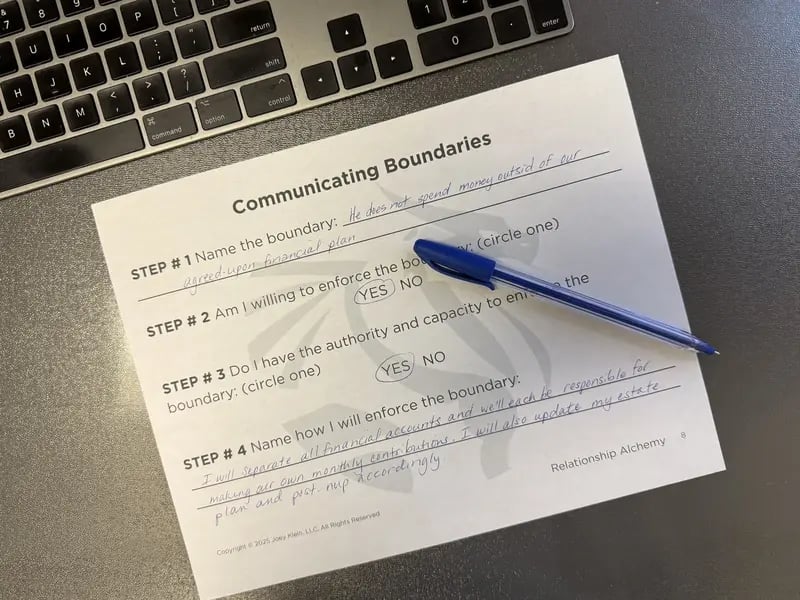
And there must be positive movement over time.
If there is no evolution — and a need-level boundary continues to be violated — something must change.
Not because you’re angry.
Because you are aligned.
This Is a Different Paradigm
As I’ve shared throughout this series, this is a different paradigm of relationship.
It redefines what relationships are for, how they’re supposed to work, and how to design them instead of just letting them become.
Boundaries are not weapons.
They are architecture.
They protect vision.
They uphold expectations.
They clarify engagement.
And when done well, they create freedom — not control.
Where We’re Going Next
Next week, we move into the final element of Relationship Alchemy: Communication.
Because communication is the vehicle for managing and upholding boundaries. The less effective we are at communication, the messier our boundaries become. The more skilled we are, the cleaner and more empowering they feel.
If you want deeper training on this — especially how to hold boundaries under emotional pressure — we’ll be working through it live next weekend at the Relationship Alchemy Intensive. There may be a handful of last-minute spots available at the time of this writing.
For now, sit with this:
In the last week, was there a boundary you tried to set… but didn’t actually enforce?
And if you’re honest — were you trying to manage the other person? Or manage your own environment?
If you’re willing, hit Reply and tell me what you noticed. Even a sentence or two.
These reflections shape where we go next and what will continue to unfold.
More soon.
Have a great rest of your day, and I’ll look forward to connecting again next week.
Joey
P.S. One more quick thing—if you’re like me and like to absorb information via audio, we’ve launched The Connection Fix Podcast. So whether you want to read, listen or watch The Connection Fix …we’ve got you covered.