
Today is Easter Sunday — so happy Easter to those who celebrate. And happy day to those who don’t.
Every year, Caitlyn’s mom makes this lamb cake from an antique mold that’s been in their family for decades. This photo is from this year’s version—it came out great! Not all year’s versions look like a lamb; this year’s pretty much did. We’ll be enjoying it later today after brunch with family and friends.
Moments like this are special to me for a simple reason.
Many years ago, long before I lived here in Colorado, I had a vision for creating a home where people could gather — friends, family, our Trainers and team — a place where real connection could be fostered.
At the time I first envisioned it, I wasn’t even living here yet.
I was in a condo in West LA.
There was a pretty big gap between where I was and where I wanted to go. As a matter of fact, I had never even owned a home before.
And bridging that gap required something most people don’t fully understand.
Intuition.
Which brings us to where we’re going this month.
One of the things I’ve noticed over the years is that most people have lost connection with their own inner guidance.
When something important comes up, we reach outside of ourselves.
We ask friends for their opinion.
We search the internet.
We scroll social media.
We look for advice from experts.
Or these days, we ask AI.
“What should I do?”
But what if the guidance system you’re looking for isn’t outside of you at all?
What if it’s already built in?
For the month of April, we’re going to be exploring the topic of intuition — and how it functions as your internal GPS.
Because intuition is always operating on your behalf.
The real question is whether it’s operating by your design.
Or whether it’s being trained accidentally by everything around you.
Intuition Is Always Working
One of the biggest misconceptions about intuition is that it’s something special that only shows up occasionally.
That’s not how it works.
Your intuition is always active.
It’s constantly processing information, looking for patterns, and working to bridge the gap between where you are and where you want to go.
But most people were never taught how it actually functions.
And because of that, we end up training our intuition unintentionally.
We defer to outside priorities.
To screens.
To substances.
To social media.
To the news cycle.
To the expectations of other people.
Before long, our attention is being directed by everything except our own vision.
And when that happens, intuition doesn’t disappear.
It simply begins working toward priorities that may not be your own.
Two Ways Intuition Actually Works
In our work, we look at intuition through two complementary lenses.
The first is neurological.
The second is deeper and far more personal.
Let’s start with the neurological side.
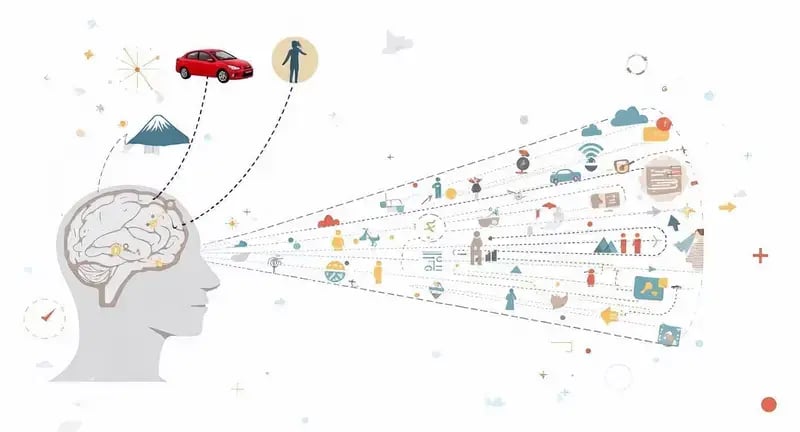 The Reticular Activating System filters millions of inputs and highlights what your brain believes is important.
Your brain contains something called the Reticular Activating System, or RAS.
Think of it as a filtering system that determines what your brain notices and prioritizes.
Your brain is essentially a supercomputer.
But like any powerful system, it needs context.
It needs to know what matters.
And the way it determines what matters comes down to three signals:
Attention & Focus.
Emotion.
The way we Invest our Time.
Focus tells the brain something is important.
Emotion amplifies and reinforces that priority.
And the way you invest your time, money, and talent tells your brain whether something truly matters.
Once those signals line up, the brain begins doing what it does best.
It starts connecting dots.
Finding opportunities.
Noticing patterns.
Solving problems.
And suddenly, you begin seeing pathways you never noticed before.
The Car You Suddenly See Everywhere
Here’s a simple example.
Let’s say you decide to buy a new car, and you land on a Subaru Outback—very popular here in Colorado.
You start imagining the trips you’ll take into the mountains.
You feel the excitement of weekend adventures.
You picture the experience you want to have.
Then something interesting happens.
As you’re driving around, you start seeing Subaru Outbacks everywhere.
On the highway.
In parking lots.
At stoplights.
They were always there. But you didn’t see them in the way you see them now.
Your brain wasn’t prioritizing them before.
The moment your focus and emotion aligned around that outcome, your brain began filtering for it. Your brain determined Subaru Outbacks are very important, and started drawing your attention to them.
That’s the Reticular Activating System doing its job.
And that’s one dimension of intuition at work.
 Once your brain prioritizes something, you start seeing it everywhere — even though it was always there.
The Second Dimension of Intuition
The second dimension is less mechanical and more personal.
The deeper you become connected with yourself — what some people call your true self, higher self, soul or simply consciousness — the more you gain access to a different kind of guidance.
It shows up as a subtle impulse.
A quiet knowing from inside.
A sense of movement toward something that feels aligned with who you are becoming.
Many people have lost touch with that signal.
Not because it disappeared.
But because our attention is constantly pulled outward.
When your focus is always on someone (or something) else’s agenda, you lose the space required to hear your own.
But when you connect with yourself — when you anchor to your own vision and priorities — that signal becomes easier to hear.
And intuition begins operating on both levels simultaneously.
Your brain starts recognizing patterns that support your vision.
And your deeper sense of self begins guiding you toward the experiences that are yours to create.
Why Vision Comes First
This is why we always begin with Vision.
If you missed it earlier in the series, we explored vision as it relates to life holistically and as it relates to designing a romantic relationship that fits within that life in Issue 005.
Vision provides the context that intuition needs.
Without vision, intuition still works.
But it works toward whatever your attention happens to prioritize.
And if that attention is being shaped by outside influences, you can end up creating a life that was never consciously designed by you.
That’s when people find themselves asking:
“How did I end up here?”
Vision changes that.
Vision tells your brain what matters.
It tells your intuition where to focus.
But there’s an important nuance here.
Vision doesn’t tell you what you’re supposed to create.
You decide the what.
Vision helps clarify how you want to experience life.
Who you want to become.
What kind of life experience you want to have.
From there, intuition begins bridging the gap from where you are to where you want to go.
What Intuition Is Not
Because intuition is so widely misunderstood, it’s worth clearing up a few myths.
Intuition is not a magical force.
It’s not a mystical “Magic 8 Ball” that tells you who to marry or what job to take.
It’s also not emotion.
This is a big one.
Many people say, “Go with your gut. Trust your feelings.”
But feelings, emotions are largely based on past programming.
If you’ve been cheated on before, your emotions may constantly warn you it’s about to happen again.
If you’ve struggled with money, your emotions may associate investing with fear.
Emotion cannot reliably guide you into something new.
Intuition is fundamentally different.
It’s a system that processes information and patterns to help move you toward what you’ve prioritized.
But that system still needs direction.
How People Accidentally Misfire
Here’s where things get interesting.
Because intuition will faithfully work toward whatever outcome you prioritize — even if that outcome is something you’re trying to avoid.
Let’s say someone becomes obsessed with not getting sick.
They keep thinking:
“I can’t get sick. I can’t lose my voice. I have an important event coming up.”
Their attention is locked on that outcome.
They’re emotionally charged about it in an intense way.
And they’re thinking about it constantly.
From the brain’s perspective, the outcome “sick” just became a priority.
Lots of attention and focus.
Lots of emotion.
So the system goes to work.
The brain starts scanning for signals related to illness.
Your focus narrows around it.
And suddenly the very thing you were trying to avoid becomes the thing you move toward.
The same thing happens in relationships.
If someone has been cheated on in the past, they may become hyper-focused on avoiding that outcome.
They watch for it.
They worry about it.
They expect it and try to prevent it.
But that obsessive attention can actually train their intuition to prioritize that pattern again.
Instead of designing the relationship they want to create, they are creating Groundhog’s Day again, and again, and again.
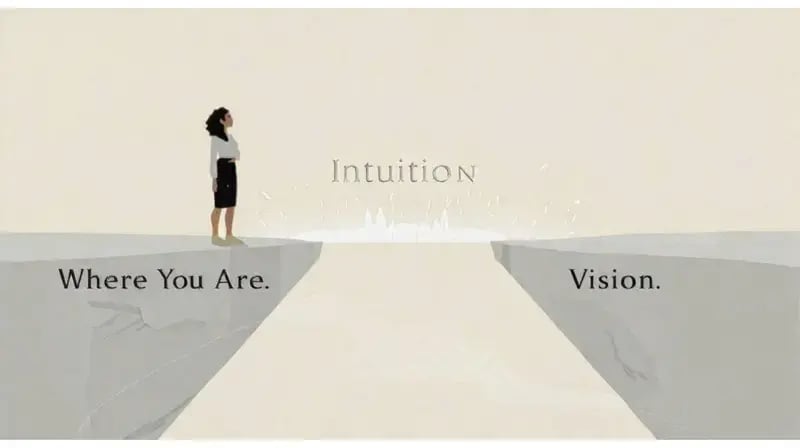 Intuition bridges the gap between where you are and the life you're creating.
Designing Instead of Drifting
This is why our work always comes back to the same principle.
Create a clear vision.
Then allow intuition to help bridge the gap between where you are and where you want to go.
Instead of drifting into outcomes you never intended.
Because when your focus, emotion, and time investment align around something meaningful to you, intuition becomes one of the most powerful forces available to you.
It begins working with you, working for you, not accidentally against you.
Where We’re Going Next
This week we introduced intuition as your internal GPS.
But knowing that the system exists is only the beginning.
Over the next three issues, we’re going to do a deep dive on the three elements that actually train intuition:
Intensity of Focus
Intensity of Emotion
Time Investment
When those three factors align with a clear vision, intuition becomes incredibly powerful.
And if you’d rather watch or listen instead of read, you can always find these teachings on YouTube or on The Connection Fix Podcast. Some people like to sit with it. Others take it on a walk.
However you train best — use that.
One Question to Sit With
Before I wrap, take a moment to notice something.
Over the past week or two, what has your mind been returning to most often?
Not what you say you want.
But what your attention actually keeps circling back to.
A problem?
A fear?
Something you’re trying to avoid?
Or a vision you’re actively designing?
If you’re willing, send me an email and share one thing your mind has been repeatedly focusing on lately.
That single pattern will tell you a lot about what your intuition is currently being trained to prioritize.
I read every response — and I appreciate you taking the time.
More soon.
Have a great rest of your day, and I’ll look forward to connecting again next week.
Joey