

We managed to do some skiing last week in this crazy Winter. This time last year, I literally had 3 feet of snow outside my window. This year, I still have grass that’s a little bit green and it's 60 degrees and sunny—so it's been a perpetual Spring here in Colorado.
Spending time in the mountains — hiking, mountain biking, skiing — has been a core part of my vision for life for a long time. It’s not just something I enjoy; it’s how I regulate, how I stay connected to myself, and how I feel most alive.
And I have a partner who genuinely wants to be up to that with me.
I’m also very clear that it's a “nice-to-have”,
It’s not a dealbreaker. And so if for whatever reason Caitlyn didn’t want to do those things with me, it would be totally okay.
It’s a strong want. But I can accept if that’s not her thing.
That distinction matters more than most people realize.
Because over the years, what I’ve seen again and again in working with people is this:
Most of us were never trained to identify what we actually want in relationship.
We weren’t taught how to separate a need from a want, or a want from a desire.
We weren’t taught how to qualify them.
And we definitely weren’t taught how to relate to them responsibly.
So instead, most of us live in a very different conversation.
We live in the conversation of what’s disappointing us.
What’s frustrating us.
What’s not happening.
What someone else should be doing differently.
And when that conversation runs long enough — especially with the people closest to us — it quietly plants the seeds of discontent.
That’s disconnection.
Without training, we sit in that soup.
Relationships slowly erode.
Marriages end.
Friendships fracture.
Families become distant or estranged.
Not because people don’t care —
but because they were never taught how to work with what’s actually happening underneath the disappointment.
Vision First, Always
Last week, we talked about Vision— and why vision is the anchor for everything that follows.
Vision gives us context.
It gives us a North Star.
It tells us what we’re actually trying to build toward — not just in relationship, but in life.
And this matters here because:
Vision should be informing what our needs, wants, and desires should be.
Just because you have a need, want, or desire doesn’t automatically mean it should be fulfilled — or that it even belongs in this relationship.
That’s a hard truth.
And a freeing one.
Vision asks a more mature question:
Does this align me with the relationship and life I actually want to create?
Without vision, needs, wants, and desires become reactive.
With vision, they become clarifying.
Why Emotions Keep Getting Us Into Trouble
Here’s where most people get tripped up.
When we feel disappointed…
angry…
resentful…
hurt…
we assume something must be wrong with the situation — or with the other person.
So we let the emotion tell us:
- what’s happening
- what it means
- and what we should do next
That’s backwards.
I say this often — and it bears repeating:
Emotions are not here to inform us about what we should do, or what’s happening externally.
They’re here to inform us where we are.
Think of emotion like a GPS.
It’s a “you are here” signal — not a set of instructions.
When you’re in a fear-based state — anger, resentment, disappointment, anxiety — that’s not proof something is wrong with the relationship.
It’s an indication that a need, want, or desire is currently unmet.
That’s it.
And if we learn how to work with that signal instead of reacting to it, everything changes.
The Simple Definitions
Let’s slow this down and define terms clearly.
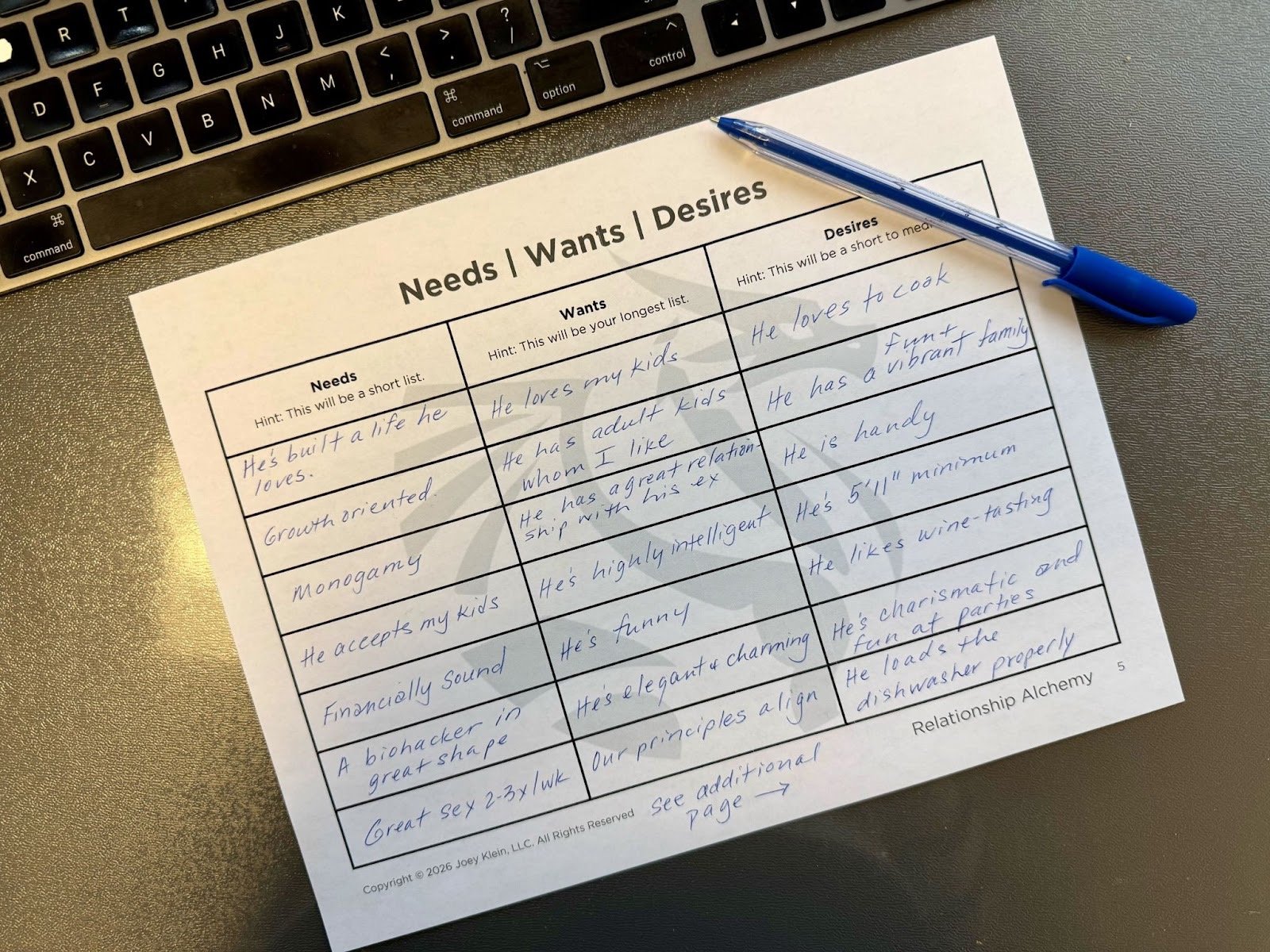 We all have needs
A need is non-negotiable.
If this is not met, the relationship cannot continue as-is — it must evolve or end.
True needs are few.
We have wants
A want is important.
You have a strong impulse for it.
But if it isn’t met — or isn’t met in this specific relationship — the relationship can still work.
We also have desires
A desire is the icing on the cake.
It’s a nice-to-have.
It’s enjoyable.
But if it never shows up, it doesn’t create pain or suffering.
Most people don’t suffer because their needs aren’t met.
They suffer because:
- everything gets labeled as a need
- nothing gets qualified
- and no one ever steps back to ask if it even aligns with vision
Using Emotion as a Radar System
Here’s a practical way to work with emotion instead of being run by it.
When you’re in a fear-based state — frustration, disappointment — ask yourself:
- What was supposed to happen that didn’t?
- What happened that wasn’t supposed to?
When you’re in a love-based state — joy, connection — ask yourself the opposite:
- What’s happening that’s supposed to?
- What isn’t happening that’s not supposed to?
This lets emotion do its actual job:
pointing you toward unmet — or met — needs, wants, and desires.
Now we’re not reacting.
We’re orienting.
What To Do Instead of React
When a fear-based emotion shows up, the work looks like this:
Step 1: Identify
Name the need, want, or desire that’s not being met.
Step 2: Confirm Alignment
Ask yourself honestly:
Should I even be holding this, based on my vision for relationship and life?
Step 3: Qualify
Is this a need?
A want?
Or a desire?
Step 4: Place It Properly
Does this belong in this relationship?
Or could it be fulfilled elsewhere — through community, friendship, creativity, purpose?
This one step alone relieves enormous pressure from relationships.
How We Usually Mess This Up
Most of us skip every step above.
Instead:
- we feel disappointed
- we assume the other person caused it
- and we try to manage them
We get upset.
We withdraw.
We explain.
We blame.
We make other people responsible for our emotional state.
And that never works.
Because no one else can regulate your nervous system for you.
That’s how we end up stuck — cycling between resentment and repair attempts that never really land.
Once you start working this way, something clicks.
You realize:
Oh… I’m not broken. I’m untrained.
And that’s hopeful.
Because once you know what you actually need — and what you don’t — relationships stop being a guessing game.
You stop outsourcing your stability.
You stop making people responsible for your inner world.
You stop confusing disappointment with incompatibility.
This is a different paradigm of relationships —
what they’re for,
how they’re supposed to work,
and how to design them, instead of just letting them become.
Where This Is Going Next
Needs, wants, and desires are only workable once they’re clearly named.
But naming them isn’t enough.
Next week, we’ll move into Expectations —
the playbook for how needs, wants, and desires are actually met.
Because clarity without structure still leads to frustration.
And this is where most relationships quietly break down.
A Place to Train This Live
Which brings me to something many of you have been asking about.
The Relationship Alchemy Intensive is coming up March 28–29, here in Denver, in one of my favorite parts of the city — Cherry Creek.
This is a live, in-person, two-day training where we take everything we’ve been talking about in this series and apply it in real time.
Over the weekend, we’ll place a strong focus on romantic relationships and do a deep dive into the five core elements of Relationship Alchemy:
- Vision
- Needs, Wants & Desires
- Expectations
- Boundaries
- Communication
This isn’t theoretical work.
It’s practical.
It’s experiential.
And it’s designed to help you actually feel the difference in how you show up — especially in the relationships that matter most.
If relationship has been the place where you feel the most activated, confused, or stuck…
if you intellectually get it, but can’t access the skill when it matters…
or if you’re ready to stop managing connection through effort, explanation, or avoidance —
this is the training ground for that.
We have a handful of spots left at the time of this writing.
If you feel the pull, you can learn more and register here:
👉 Relationship Alchemy Intensive – March 28–29 | Denver (Cherry Creek)
Whether or not you join us in Denver, I want to leave you with this:
When disappointment shows up in relationship, it isn’t a verdict.
It’s information.
It’s your system telling you:
Something important to you hasn’t been named, qualified, or placed yet.
That doesn’t mean you’re failing.
It means you’re learning.
So for now, sit with this question:
When I feel disappointed, do I know what I’m actually wanting — and have I ever decided whether it’s a need, a want, or a desire?
If you want to share, hit reply.
Even a sentence or two.
And if not, just notice what becomes clearer as you hold the question.
More soon.
In the meantime, have a great rest of your day, and I’ll look forward to connecting again next week.
Joey
P.S. If you’d rather watch or listen than read, you can always catch episodes of The Connection Fix on my YouTube channel.