


This photo was taken between client sessions — one of those quiet pauses at my desk, sitting with the reality of how many people are navigating relationships that feel confusing, painful, or stuck.
What strikes me, after thousands of these conversations, is how often the same word sits just beneath the surface of the struggle.
Expectation.
One of the most misunderstood concepts in relationship is expectation.
Most of us hear the word and immediately associate it with disappointment, pressure, or control. We’re taught — explicitly or implicitly — that expectations are the problem. That if we didn’t expect so much, we wouldn’t suffer so much.
There’s truth there… but it’s incomplete.
Because expectations aren’t just the root of suffering.
They’re also the key to fulfillment.
The issue isn’t that we have expectations.
The issue is that most of us were never taught how to hold the right ones.
What an Expectation Actually Is
In the context of this work, an expectation is very simple:
An expectation is the holding of a need, a want, or a desire inside of a particular relationship.
That’s it.
Expectations don’t come out of nowhere. They’re downstream from everything we’ve been talking about in the last few issues.
Vision (Issue 005) gives us context for what we’re building toward.
Needs, Wants & Desires (Issue 006) clarify what matters and at what level.
Expectations are how we hold those needs, wants, and desires with real people.
When expectations are aligned with vision—and matched with the right person—they create stability, trust, and fulfillment.
When they’re misaligned, unreasonable, or unspoken, pain is inevitable.
Why Expectations Hurt So Much
Most suffering in relationship isn’t caused by conflict.
It’s caused by unmet expectations that were never named, evaluated, or consciously chosen.
We feel disappointed.
We feel resentful.
We feel let down.
And instead of asking, What expectation am I holding right now?
We assume something is wrong with the other person—or the relationship itself.
But here’s the thing most people miss:
If you’re holding an expectation that can’t be met in a particular relationship, no amount of communication will fix that.
And if you’re holding an expectation that doesn’t lead toward the life you actually want, even having it met won’t bring fulfillment.
That’s why expectations can feel so torturous.
Not because expectations are bad — but because unexamined expectations inevitably create pain.
Holding the Right Expectations
Fulfillment doesn’t come from having all expectations met.
It comes from holding the right expectations—and managing ourselves well around the rest.
This is where maturity comes in.
Needs, wants, and desires represent different levels of expectation:
- Needs are non-negotiable. If a core need goes unmet long enough, the relationship will eventually end.
- Wants are important, but flexible. They may be evolved, met elsewhere, or accepted as unmet without destroying the relationship.
- Desires are icing on the cake. If they’re not happening, we can stop looking for them and be genuinely okay.
Most people never make these distinctions.
They treat everything they want as a requirement.
And then wonder why they feel perpetually disappointed.
A Simple Framework for Evaluating Expectations
In Relationship Alchemy, we use a clear framework to evaluate whether an expectation is reasonable.
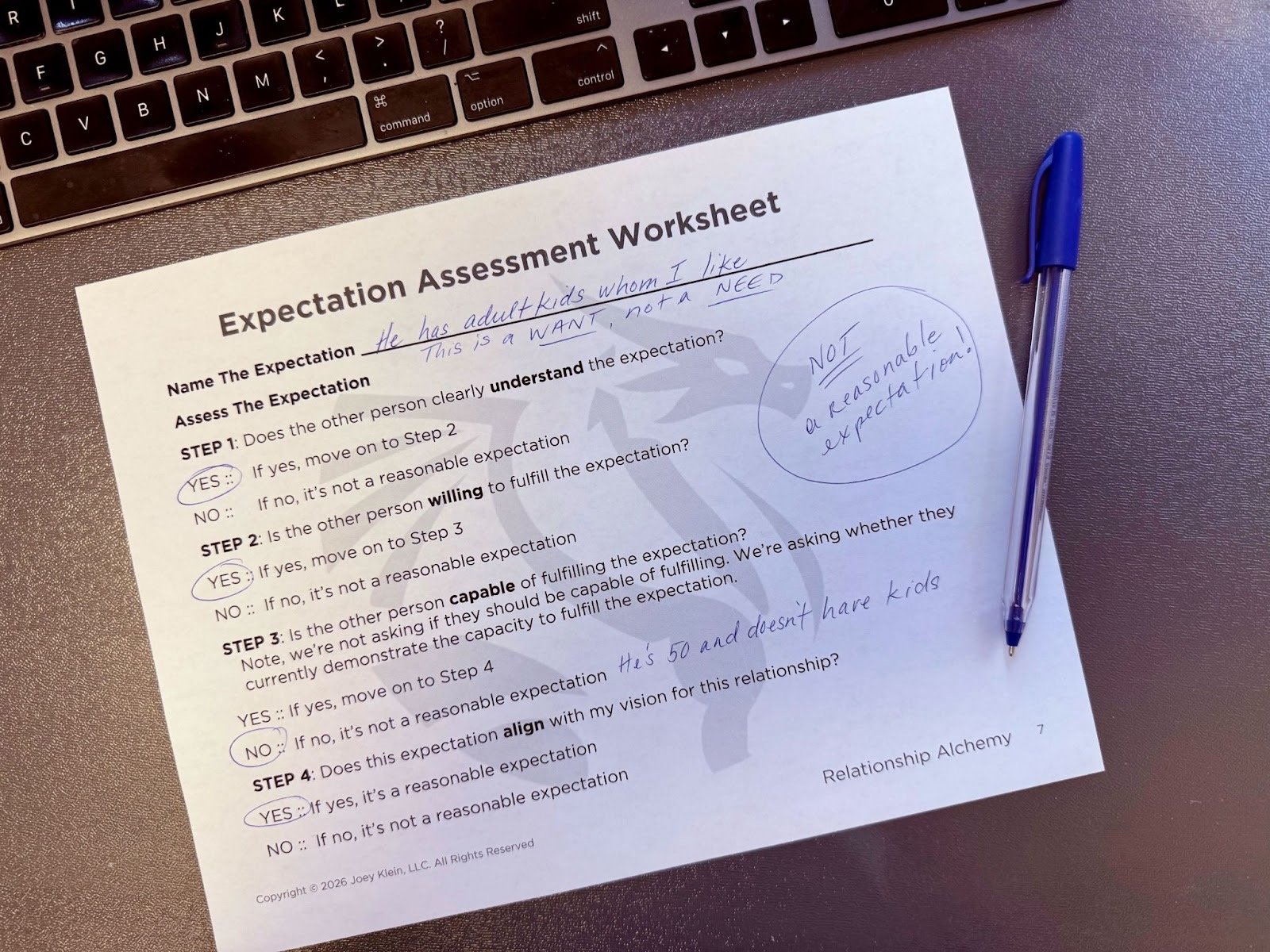 I’m not going to train this fully here — but even a high-level pass can start to change how you relate to disappointment.
For an expectation to be reasonable, all four of the following must be true:
#1: Does the other person clearly understand the expectation?
If they don’t clearly understand what you’re expecting, it isn’t reasonable to hold them accountable for meeting it.
Unspoken expectations are one of the fastest ways to create unnecessary resentment.
If the answer is no — it’s not a reasonable expectation.
#2: Is there real willingness on their part?
Someone may understand what you want — but not be willing to prioritize it, sustain it, or take responsibility for it.
Willingness matters.
If the answer is no — it’s not a reasonable expectation.
#3: Is this person actually capable of meeting this expectation?
And this is important:
We’re not asking if they should be capable.
We’re asking whether they currently demonstrate the emotional, logistical, or developmental capacity to fulfill it.
Someone may care deeply — and still not have the capacity.
Capability without willingness doesn’t work.
Willingness without capability doesn’t work.
If the answer is no — it’s not a reasonable expectation.
#4: Does this expectation move you toward the vision you want for your life and relationships?
Even if someone understands it…
Even if they’re willing…
Even if they’re capable…
That doesn’t automatically mean the expectation belongs.
If it pulls you away from your vision — if it reinforces a dynamic that doesn’t align with the life you actually want — it will cost you in the long run.
If the answer is yes — it’s a reasonable expectation.
If no — it isn’t.
If any one of these four breaks down, the expectation will eventually create frustration, resentment, or confusion — not fulfillment.
And one more critical reminder:
Needs, wants, and desires are different levels of expectation.
They require different responses.
Different conversations.
And different levels of self-management.
When we collapse them into one category, everything feels urgent — and nothing gets resolved.
What to Do When Expectations Go Unmet
When a need goes unmet, something has to change. The relationship will evolve—or end.
When a want goes unmet, you have options. You can evolve it, meet it elsewhere, or accept that it won’t be fulfilled here.
When a desire goes unmet, maturity looks like letting it go. Not suppressing it—but stopping the search for it to be met by that person.
Fulfillment doesn’t require that everything you want happens.
It requires that you stop making yourself miserable over what isn’t essential.
That’s not resignation.
That’s self-leadership.
What This Makes Possible
Once you start working with expectations this way, a lot of emotional noise settles.
You stop confusing disappointment with incompatibility.
You stop making people responsible for regulating your nervous system.
You stop escalating pain that never needed to escalate.
And you begin relating to expectation as a conscious choice—rather than an unconscious demand.
This is a different paradigm of relationship.
What relationships are for.
How they’re supposed to work.
And how to design them—rather than just letting them become.
Where This Is Going Next
Expectations don’t stand on their own.
Next week, we’ll move into Boundaries—which are simply the upholding of expectations with other people.
And one important teaser before we get there:
Boundaries are not something you set after they’ve been crossed.
That’s one of the most common—and costly—mistakes people make.
More on that next.
A Quick Note for Those Asking
For those of you who’ve written in asking how to move beyond insight and actually build skill—in real time, under relational pressure—The Relationship Alchemy Intensive is coming up March 28–29 here in Denver (in my favorite part of the city, Cherry Creek).
For Now, Sit With This
Before I sign off, I want to leave you with a simple reflection.
In the last 24–48 hours, was there a moment of disappointment, frustration, or resentment?
If so, ask yourself:
What expectation was I holding—and was it a need, a want, or a desire?
You don’t need to fix anything.
Just notice it for now.
And if you’re willing, send me an email and share what you discovered—even a sentence or two.
I read every message. And these reflections help shape what we explore next.
More soon.
Have a great rest of your day, and I’ll look forward to connecting again next week.
Joey
P.S. Next up: Boundaries—what they actually are, why most people get them wrong, and how to use them without threat, withdrawal, or force.