Over the last few weeks, we’ve named something real.
We’ve named the Connection Crisis (Issue 002)— not as a personal failure, but as a lived experience many of us share.
We’ve explored why so many of us reach for screens or substances — not because we’re broken, but because we were never taught how to regulate ourselves from the inside out.
And we’ve started talking about a third path: state management through self (Issue 003).
This issue is more personal.
It’s about how this work was forged — not as a concept, but as a necessity.
I want to take you somewhere personal today.
Not because my story is the point.
But because the Connection Crisis we’ve been talking about isn’t theoretical — and the work I teach didn’t come from theory either.
It came from living inside the exact patterns we’ve been naming:
- feeling disconnected
- trying to manage pain from the outside
- realizing awareness isn’t enough
- and eventually discovering that the only real way out… is training a relationship with yourself that actually works.
This is how that happened for me.
I did not grow up in an environment saturated in peace, love, and joy.
On the outside, things may have seemed normal.
Behind closed doors, life was permeated by anger, conflict, resentment, pain, and suffering.
As I approached my teenage years, I began noticing something with increasing clarity: the people around me were unhappy. Not just at home — everywhere. Parents. Teachers. Adults I was supposed to learn from.
They were disconnected. Frustrated. Flat.
There was no passion. No inspiration.
Something was clearly missing.
And I remember feeling this quiet, stubborn insistence inside me:
I want more than this.
I was convinced I could live in peace and serenity. I believed unconditional love and fulfillment had to be real — not as a concept, but as an experience. The problem was, I didn’t know anyone who had achieved that. I had no model.
So I did the only thing I knew how to do.
I turned inward.
I started an internal dialogue, searching for any clue that could help me. Over and over I asked myself:
What is my purpose? Who am I? Why am I here?
I didn’t have answers. But I had intention. And I put real emotion behind that intention.
Looking back, that’s where the whole arc begins.
Because the Connection Crisis isn’t just “out there.”
It’s what happens when we don’t know how to anchor in here.
As soon as I was able, my best friend and I moved out of our parents’ homes. We got an apartment with our girlfriends. We thought we were stepping into freedom — finally.
But our sense of freedom and excitement quickly morphed into something we didn’t anticipate.
Instead of focusing our energy on creating a better way to live, we used it to rebel against the old one.
I was trying to find a solution by focusing on the problem — on everything I didn’t want to become.
And I know now: that approach will almost always create more of the same.
My new world became chaotic. And it ended up being filled with even more suffering than the place I’d just come from.
I worked a meaningless job by day.
By night, we partied.
Before long, my inner world was flooded with hopelessness and despair.
So I started numbing myself with drugs and alcohol to avoid the pain of my circumstances and choices.
And the cycle did what it always does:
The more I numbed, the worse things got.
My girlfriend cheated on me with one of my best friends.
And my relationship with my best friend naturally blew up.
And here was the brutal part:
Even though I was aware of patterns — even though I could see what I didn’t want — awareness didn’t give me the ability to change anything.
That’s one of the biggest lies we’re sold:
“If you can just understand why you do what you do, you’ll stop.”
That was not my experience.
In fact, my awareness almost felt like it accelerated the pain, because I could see the cliff… and still couldn’t stop walking toward it.
That’s the Connection Crisis in miniature.
We can be smart. Self-aware. Insightful.
And still be trapped.
Because insight isn’t the same as capacity.
Eventually, I hit rock bottom.
An evening of partying began like any other, and this time I spiraled out of control. One night of heavy drinking and drugs turned into three — with no food and no sleep.
Well into the third night, I was watching a movie with friends when suddenly a band of dancing bears appeared — cavorting around the living room.
I was delighted.
No one else was.
At first I couldn’t understand why no one wanted to dance with the bears.
Then I started noticing the horrified looks on some of their faces.
I realized I was hallucinating.
I excused myself and went to my room to get some sleep. I lay on my bed awake, and eventually decided to get a glass of water. But when I tried to sit up, nothing happened.
I couldn’t move my body.
Then I became aware of my heartbeat behind my ear — and the fact that it was slowing down.
Moments later I experienced the sensation of hovering above my own body, looking down at my motionless form on the bed. Then, with a jolt, I was back in my body.
In that moment, I knew something beyond the shadow of a doubt:
If I stayed in that life, I would soon be dead.
And I knew something else just as clearly:
I hadn’t come into this life to waste it in an alcohol- and drug-induced haze. I had no intention of living a mundane, meaningless existence.
I had a sense that I was meant for more.
So I said goodbye to what I’d thought was going to be a fairytale existence out on my own… and I went back to my parents’ basement.
That’s where my real journey began.
And this is important:
That moment wasn’t “inspiring.” It was sobering.
It was the moment I realized that state management through substance wasn’t a solution for me — it was a slow-motion exit.
I needed a different path.
There’s another key element of my family life that I didn’t realize was unusual until I had some distance from it – violence was part of the fabric of my family.
I grew up with two half brothers who were substantially older than I was.
Our friendliest of interactions included a punch in the arm. Other interactions included regular beatings, being smothered and trapped, and on one memorable occasion, being hogtied with duct tape.
I don’t harbor resentment toward them—they were simply playing out the patterns they learned.
So violence wasn’t abstract in my life. It was cultural.
In later years, my sister’s estranged husband broke into her house and shot himself in front of her. And my cousin was murdered by his girlfriend — shot five times in the heart.
I’m not sharing these details for shock value.
I’m sharing them because when you’ve been close to events like these, you stop thinking of emotions as “just feelings.”
You see what happens when inner instability goes untrained.
You see what fear, despair, rage, and dissociation can do when they take the wheel.
And you realize something most of us don’t want to face:
If we don’t learn how to regulate what’s happening inside us, it doesn’t just affect us.
It affects everyone around us.
Sometimes in ways we can’t undo.
It becomes family legacy.
This is why I don’t talk about regulation like it’s a luxury.
It’s a foundation.
After my near-death wake-up call at nineteen years old, I felt a pull to seek out teachers who could show me other ways of being.
I set a vision for peace and fulfillment, and I stayed open and alert.
And it’s true: when the student is ready, the teacher appears.
I happened upon a best-selling author focused on healing modalities. I had a conversation with him, and he invited me to train with him — which I did for a year.
Then one after another, I encountered experts and masters in disciplines ranging from psychology and neuroscience to martial arts and meditation.
With each teacher, I didn’t just “learn ideas.”
I lived what I was learning.
I found myself in temples and ashrams around the world — in places I never expected I’d be — studying ancient wisdom traditions, modern psychology, and cutting-edge neuroscience.
And I began to see something I hadn’t seen in my early life:
People who were anchored internally.
People who could stay calm in intensity.
People who could meet suffering without collapsing into it.
People who could actually shift.
I studied with a spiritual mentor at an ashram in India where I watched them guide people through evolutions that would eliminate deep, long-term suffering — sometimes in hours. In rare cases, in minutes.
And I remember thinking:
So this is real.
Not theory. Not motivation.
A real internal shift that changes the baseline.
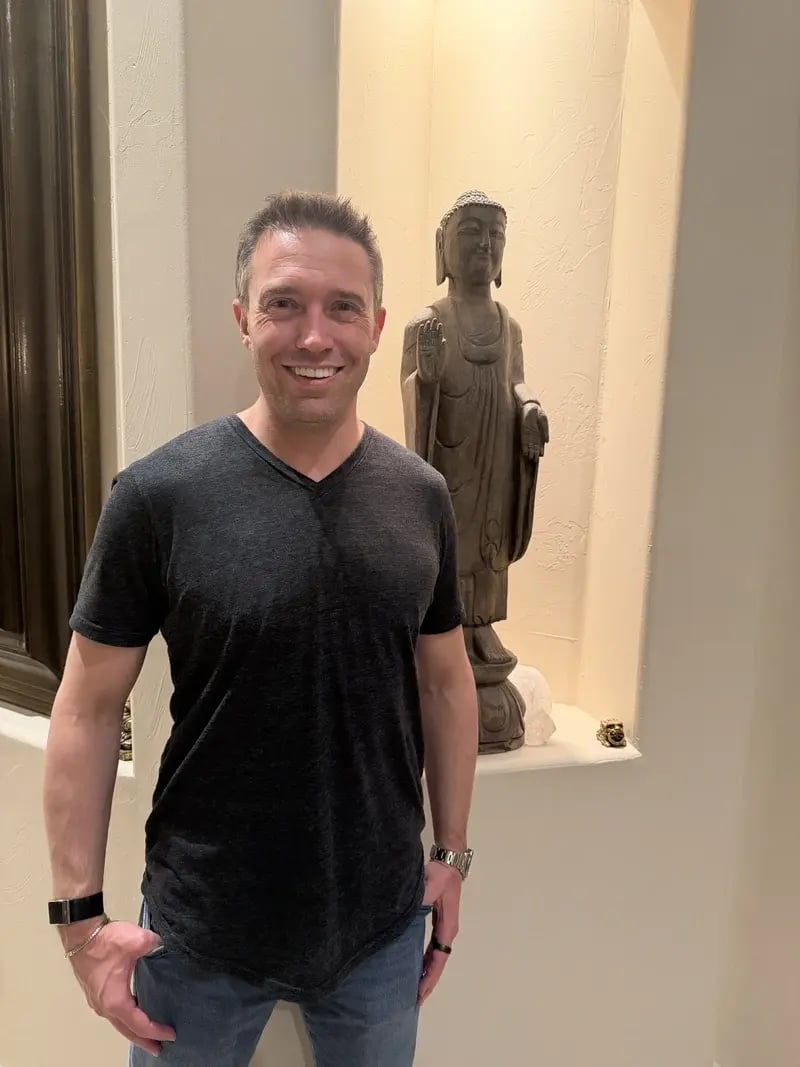
One of the most pivotal influences in my journey was a mentor anchored in ancient wisdom techniques.
And what they had me do was almost the opposite of what we do today when we’re in pain.
They had me disconnect from the world in order to reconnect to myself.
No television — the internet didn’t even exist at that time.
No substances.
Clean up my diet.
And then: training.
Training my emotions.
Training my thought strategies.
Training my nervous system.
It wasn’t dramatic.
It was practical.
And for the first time in my life, I felt something I didn’t know was possible:
Peace in and as myself.
Not because life got perfect.
But because I was learning how to work with what was happening inside me — in real time — without needing to outsource my stability.
And that’s the seed of The Connection Fix right there:
When we don’t know how to be with ourselves, we reach outward.
When we learn how to be with ourselves, we stop needing the world to regulate us.
I also deepened my study of martial arts — which I had begun as a kid.
I earned my black belt in Okinawan-Kenpo at age 14.
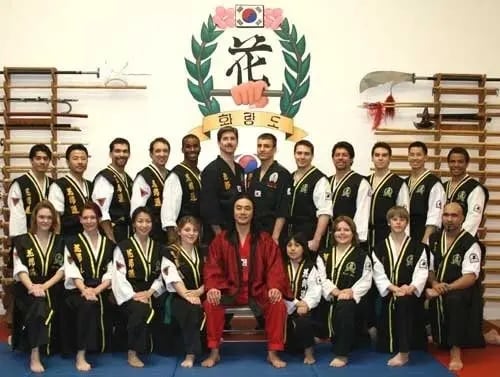
In Los Angeles, I met a traditional master who taught me how to train my body as a warrior — not only through physical training, but deep internal practices to cultivate energy, or chi.
And then something interesting happened — competition humbled me.
I trained hard. I worked hard. I did everything I knew how to do — and yet, I still hit a ceiling.
In practice at the dojang, I was unbeatable.
Under pressure in competition, I’d choke.
That challenge brought everything into focus:
My problem wasn’t skill.
It was fear. Pressure. Emotional reactivity.
When I learned how to work with what was happening inside me — the fear, the pressure, the activation — everything changed.
I was able to connect the dots on not only how to feel more peaceful and grounded within myself, but how to leverage that new skill I developed to create actual results in the external world.
That shift took me from struggling to becoming a three-time world champion in Hwa Rang Do.
Not because I wanted it more.
Because I was regulated enough to access what I already had.
That’s when I understood something that most people never get taught:
The inner game determines the outer result.
As I continued to train and study, I began to see a pattern:
Ancient wisdom traditions had consistent results.
Modern science could explain why those results were possible.
I was studying psychology, neuroplasticity, epigenetics — and I began to understand from a scientific standpoint what I was experiencing firsthand.
So I asked my teachers for permission to take what I had learned and create a new approach.
I let go of ritual and dogma, and kept only the core principles and actions that were effective at producing results.
And then something surprising happened:
As my inner state shifted, the people around me shifted too — even my parents.
My father stopped his constant complaining and began to enjoy his work.
My mother began to experience contentment.
Seeing those evolutions, I knew I had found my life’s work.
So I started collecting data points from everything I had learned to create a reliable system of evolution.
And I want to emphasize something:
Radical transformation can be instantaneous.
Mastery takes time.
That’s been true for me, and it’s true for the thousands of people I’ve trained.
Over time, my psychologist mentor, Dr. LaWanda Katzman Staenberg (Dr. Lu), began referring me some of her most challenging cases — clients who were no longer making progress no matter what they’d tried.
In many cases, the methods I provided sparked the breakthrough.
It wasn’t long before I had a thriving private practice with over 60 clients on my books.
The waitlist grew.
And that’s when the work began to scale — not because I planned it, but because clients demanded it.
As people experienced real change, they asked me to hold seminars so their friends, family members, and coworkers could learn the approach.
So I began offering weekend intensives where I could work with many people at a time.
Ultimately, these programs expanded — over the last twenty-two years, I’ve taught an average of 35 programs each year. To date, this work has served nearly 90,000 people.
And this is the piece I want you to feel in your bones:
This didn’t grow because I wanted to build something.
It grew because the Connection Crisis is real — and people were starving for a third path.
Not more coping.
Not more outsourcing.
Not more “fix me.”
Training!
If you zoom out, you can see why this matters right now.
When we don’t know how to regulate our internal state:
- our mind spins
- we lose self-trust
- relationships become fragile
- repair becomes rare
- conflict becomes threatening
- and loneliness becomes the baseline
Then we do what humans do.
We reach.
Screens. Substances. Anything that can stabilize the chaos.
But the heart of the Connection Crisis isn’t technology.
It isn’t medicine.
It isn’t psychology.
It’s the loss of relationship with self.
And the work I teach exists for one reason:
To rebuild that relationship — in real time, in real life — so we don’t have to outsource our stability, our clarity, or our sense of direction.
This is why I say the most important relationship we have is the one we have with ourselves.
Because your emotions, mind, nervous system, and intuitive aspect comprise a matrix that shapes your inner experience — and your inner experience shapes everything else.
How you show up under pressure.
How you respond when you feel misunderstood.
How quickly you recover after rupture.
How much of yourself you bring into connection — or withhold.
When you master your internal state, you master your world.
But here’s the part most people don’t expect:
You don’t actually discover the quality of your relationship with yourself in isolation.
You discover it in relationship.
Because relationship is where our inner training — or lack of it — gets exposed.
Relationship is the ultimate proving ground for this work.
Nowhere are we more triggered.
Nowhere are we more reactive.
Nowhere are our patterns more alive.
With the people we love, our nervous systems don’t get to hide.
Our emotional habits come online automatically.
Our untrained responses surface — not because we want them to, but because they’re conditioned.
That’s why so many people can feel regulated, insightful, and grounded on their own —
and then feel completely destabilized inside relationship.
It’s not because they’re failing.
It’s because relationship applies pressure.
And pressure reveals capacity.
This is also why the Connection Crisis shows up so clearly in our closest bonds.
When we don’t know how to regulate ourselves:
- we take things personally
- we become defensive or withdrawn
- repair feels threatening
- and conflict becomes something to survive rather than something to work through
Over time, connection erodes — not from lack of love, but from lack of skill.
And that’s where relationship stops being a source of nourishment… and starts feeling like a source of exhaustion.
This is the context from which my Relationship Alchemy curriculum emerged.
Not as a “relationship program, “ but as a training ground.
A place to take everything I teach about emotional regulation, nervous-system literacy, self-trust, and inner authority — and apply it where it matters most.
Because if you can stay connected there — if you can remain regulated in intimacy, disagreement, and repair — the rest of life gets easier, not harder.
The Relationship Alchemy curriculum can be accessed in a few different forms:
- the book — Relationship Alchemy: A Practical Guide to Getting Along With Others
- the online MasterClass
- and the in-person, two-day Relationship Alchemy Intensive
The Relationship Alchemy Intensive is happening March 28–29, 2026, in Denver.
This is where we train this work in real time —
with real people,
inside real relational dynamics,
under the kinds of pressure where patterns normally take over.
If relationship has been the place where you feel the most triggered, the most confused, or the most disconnected — that doesn’t mean you’re bad at relationships.
It means relationship is asking you to build a deeper relationship with yourself.
And this Intensive is designed to teach you how.
If you’re ready to stop managing relationship through effort, explanation, or avoidance — and start meeting it with regulation, presence, and skill — Relationship Alchemy is the next step.
I’ll be sharing more details and context in the coming weeks.
We’ll also begin exploring the five core elements of Relationship Alchemy:
- Vision
- Needs, Wants & Desires
- Expectations
- Boundaries
- Communication
These are the building blocks of connection — and we’ll take them one at a time, grounding each in real-life application.
For now, thank you for spending this time with me and walking this arc.
Have a great rest of your day, and I’ll look forward to connecting again next week.
Joey
P.S. If you haven’t already checked out The Connection Fix on YouTube, you’ll find it here.